Why You Should Stop Using Goodreads (And What to Use Instead)

If you’re a reader, you’ve probably used Goodreads at some point. Maybe you still do. It’s where you track what you’ve read, set your yearly goals, scroll for recommendations, and, let’s be honest, judge books by a star system that was never built to hold the weight we’ve put on it.
But something has shifted. And not in a good way. What used to feel like a cozy corner of the internet for book lovers now feels…off. Clunky. Performative. Weirdly aggressive. Like the soul of reading got replaced with metrics. Goodreads didn’t just age poorly. It got absorbed into something bigger, and more transactional.
Goodreads and Amazon: How Book Culture Got Pulled Into a Monopoly
Goodreads was founded in 2007 and then acquired by Amazon in 2013. That matters a lot. Once that happened, Goodreads stopped being just a reading platform. It became part of a much larger machine that is fundamentally built to sell. And not just sell books, but control the entire ecosystem around them.
Amazon doesn’t just function as a bookstore. It owns distribution, self-publishing through KDP, marketing infrastructure, recommendation algorithms, and now, one of the primary spaces where readers talk about books. That’s not participation in the literary world. That’s vertical integration. It’s ownership of the pipeline from creation to consumption. So when your reading platform is embedded inside that system, it’s not neutral anymore.
Discovery isn’t really discovery. It’s influenced by what’s already performing well, what’s being pushed, and what’s financially viable to scale. Visibility isn’t organic. It’s tied to preorders, ad spend, publisher backing, and algorithmic momentum. The books you see are often the books that are already winning.
And that creates a feedback loop: The most visible books get more attention, which drives more sales, which boosts their visibility even further.
Meanwhile, quieter, riskier, more experimental, or marginalized voices struggle to break through because they don’t fit cleanly into a system built for mass appeal. This is how literary taste gets subtly engineered. Not through force, but through repetition. Through what’s surfaced, what’s recommended, what’s constantly in front of you. And over time, your sense of what’s “worth reading” starts to narrow without you even realizing it.
There’s also the data layer, which people don’t talk about enough. Every book you shelve, rate, review, or browse feeds into Amazon’s understanding of you as a consumer. Your reading life becomes behavioral data used to refine recommendations, yes, but also to optimize what gets sold, how it’s marketed, and who it’s shown to. You’re not just a reader in that system. You’re a data point inside a retail strategy.
And this is where things get uncomfortable, because books are not just products. They’re ideas. They’re experiences. They’re art. And when you run art through a system designed for commerce, something gets flattened. Nuance gets replaced with performance. Curiosity gets replaced with optimization. And reading starts to feel less like exploration—and more like consumption.
At some point, we stopped noticing that the space we use to talk about books is owned by the same entity that profits from what we buy, and that should probably bother us more than it does.
In fact, I don’t even recommend buying books on Amazon. I won’t give Jeff Bezos that satisfaction. At least, not as it applies to the publishing industry and the way his dominance is changing things. Here’s a resource on five places you can buy books that are not Amazon, if you’re interested.

The Goodreads Experience Is… Kind of a Mess
Let’s not pretend the user experience is great. It’s not. The site feels like it hasn’t meaningfully evolved in over a decade. It’s glitchy, unintuitive, and honestly frustrating to use. Which is wild considering the resources behind it. But the bigger issue isn’t just the interface. It’s the culture that’s formed around it.
Goodreads has created an environment where books and the people who write them are constantly under surveillance. Review bombing happens before books are even released. Readers (and sometimes non-readers) flood a title with low ratings based on controversy, assumptions, or just internet discourse. Entire careers can be shaped by numbers that have nothing to do with the actual reading experience.
And the reviews themselves? They often aren’t about engaging with a book thoughtfully. They’re about being clever, being harsh, and being visible. It’s not criticism. It’s performance. And authors are expected to just… exist in that space. To watch. To absorb it. To not respond. That’s not a healthy literary ecosystem. That’s a pressure cooker.
The Star Rating System Is Breaking How We Talk About Books
In my opinion, you cannot reduce a book to a number. A 3.8 vs a 4.2 does not tell you anything meaningful about a piece of writing. It doesn’t capture nuance, emotional impact, complexity, or context. It just flattens everything into a quick, digestible judgment. And once that becomes the dominant way we evaluate books, it starts shaping how we read them too.
We stop asking: What did this book do to me? And start asking: Is this worth five stars? That shift matters. It changes the entire relationship between the reader and the text.
Goodreads Blurs the Line Between Reader Space and Marketing Machine
Goodreads claims to be for readers, but it’s also deeply tied to authors and publishers trying to sell books. That tension is baked into the platform. Authors are encouraged to engage, but not too much. Promote, but not obviously. Exist, but not react. It’s a weird, uncomfortable dynamic where everyone is slightly performing and no one is fully honest.
Meanwhile, the “to-read” button has become a predictive sales metric. Buzz gets manufactured before a book even exists in the real world. Hype becomes currency. And once again, the focus shifts away from the reading experience and toward market performance.
This Isn’t Just About Goodreads. It’s About What We’ve Let Reading Become.
Goodreads isn’t the root problem. It’s a symptom. It reflects a larger cultural shift where reading has been pulled into the same system as everything else: optimized, quantified, and monetized.
Books become “content,” readers become consumers, and taste becomes something that can be gamed. We’ve slowly accepted a version of literary culture that is louder, faster, and more reactive, but also shallower. And I don’t think that’s what most of us actually want.
So What’s the Alternative? Enter StoryGraph
This is where the conversation changes. Because there is another option. And it feels completely different.
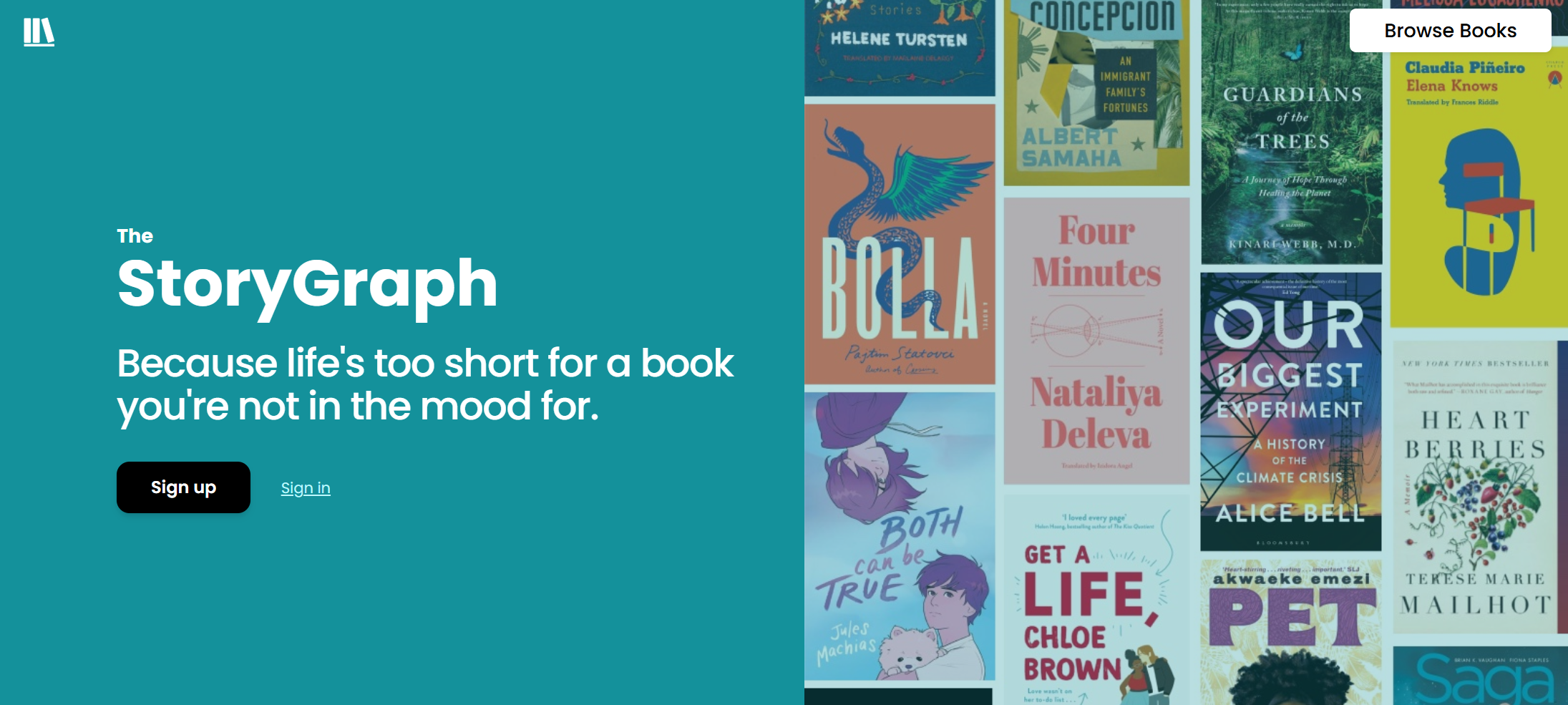
StoryGraph is a newer platform that’s quietly been building something Goodreads never quite managed to protect: a reader-first experience. And you feel that difference immediately.
StoryGraph doesn’t try to be everything at once. It’s not trying to be a social media platform, a marketing engine, and a review battlefield all in one. It’s focused on one thing: helping you read in a way that feels aligned with you.
Instead of pushing hype, it asks about your mood. Instead of generic recommendations, it uses nuanced preferences. Instead of flattening books into stars, it gives you context, like pace, tone, and emotional impact. It treats reading like a personal experience, not a public performance. And that alone changes everything.
StoryGraph is independently owned, which means it’s not tethered to a massive retail ecosystem. That matters more than people realize because it removes that underlying pressure to constantly convert attention into sales. It creates space for something quieter, more intentional, more human. You’re not being funneled toward what sells best. You’re being guided toward what might actually resonate.
It also encourages you to think about how a book felt, not just how you’d rate it. It nudges you toward reflection instead of reaction. And weirdly, it makes reading feel like yours again. Not something you’re tracking for validation. Not something you’re performing for an audience. Just… something you’re doing because it matters to you.
I love it because it allows me to exercise my love for leaving editorial reviews on books without that being the primary focus of the platform itself. It also allows me to track the books I’m reading and the patterns that fall within my reading habits. Plus, it connects me to recommended books based.
Overall, I think the system is much cleaner and more organized, too, which is super important to me.
The Bottom Line: You Don’t Have to Stay in a Broken System
Goodreads still dominates because it’s familiar, it’s embedded, and everyone is there. But that doesn’t mean it’s good. And it definitely doesn’t mean you have to keep using it.
If you’ve felt that quiet frustration, the sense that something about reading online just feels off, you’re not imagining it. You’re responding to a system that was never really built with you in mind. So leave it. Stop giving your attention to something that doesn’t respect the depth of what reading actually is.
Move somewhere that does. StoryGraph isn’t perfect. But it’s a hell of a lot closer to what reading should feel like. And honestly? That’s enough to make the switch.
Let’s be friends on Storygraph.