How to Build a Consistent Writing Practice (Even If You Feel Uninspired)

If you want to be a writer, you have to write. Not think about writing, plan to write, or wait for the perfect idea, the perfect mood, or the perfect version of yourself to show up. You have to sit down and actually do it. Uninspired. Unmotivated. Uncertain. You just have to write.
Despite how much you may resist this, there is no version of becoming a strong writer that doesn’t require you to write consistently, especially when it feels uncomfortable, inconvenient, or uninspired.
One of the most important lessons I learned from The Artist’s Way is that you have to be willing to be a bad writer before you become a good one. You want to write something beautiful, something meaningful, something that sounds like the version of yourself you have in your head. I get that. You want to skip over the awkward sentences, the flat ideas, the pieces that don’t quite land. But that awkward, unpolished, sometimes painfully mediocre writing is the real work. That’s where your voice gets built.
You don’t find your voice by waiting until you have something brilliant to say. You find it by saying a lot of things that aren’t quite right yet, and staying long enough for something honest to come through. Yes, classes and workshops matter. Craft books matter. Studying structure, technique, and storytelling matters. But none of it replaces the act of writing. You don’t become a writer by consuming information about writing. You become a writer by practicing it.
And just as important is reading. If you want to write well, you have to read. Not occasionally, not passively, but consistently. Reading teaches you things you won’t even realize you’re learning: rhythm, pacing, tone, what holds attention, what falls flat. It sharpens your instincts in a way nothing else can.
But even with all of that—reading, studying, learning—the thing that will move you forward the fastest is still showing up on the page. Consistently.
By consistently, I don’t necessarily mean for two hours a day if your life doesn’t allow that. Consistency is not about intensity. It’s about repetition. Your writing practice might be 10 minutes in the morning before your day begins. It might be 30 minutes three times a week. It might be one hour after your kids go to bed when the house finally goes quiet. It might be messy, interrupted, imperfect. It still counts.
What matters is that you choose something, and you stick to it. Writing is not built in grand, cinematic bursts of inspiration. It’s built in small, repeated acts of showing up. And this is where most people get stuck, because you’ll tell yourself you’ll write when you feel inspired but inspiration is unreliable. It comes and goes. It shows up when it wants to. And if you build your writing life around waiting for it, you will spend far more time waiting than writing.
You don’t wait for inspiration to begin. You begin, and let inspiration meet you there. You sit down when you don’t feel like it. You write when your mind feels blank. You keep going when what you’re writing feels average at best. And somewhere in the middle of that, something shifts. A sentence lands. An idea opens up. Something clicks. That’s what happens when you give yourself enough time on the page for your mind to move past resistance.
Another thing that will hold you back (if you let it), is the belief that everything you write needs to be good. It doesn’t. Not everything you write needs to be shared. Not everything you write needs to be polished. Not everything you write needs to be something you would ever publish. In fact, most of your writing should exist outside of that pressure.
When you only allow yourself to write things that feel “good enough,” you stop yourself from experimenting. You stop yourself from being honest. You start performing instead of creating. And performance will kill your growth faster than anything else.
You are not here to constantly prove that you’re a good writer. You are here to become one, which requires space to be messy, to be inconsistent in quality, to try things that don’t work, to follow thoughts that go nowhere. That’s how you build range. That’s how you build depth. That’s how you build something real.
Creativity is a gift, and your responsibility is to engage with it. Not perfectly or impressively, but consistently. To take it seriously enough to show up for it.
So this is your permission, if you’ve been waiting for it: Write badly. Write honestly. Write when you feel like it, and especially when you don’t. Stop waiting to feel ready. Start building a practice that makes you ready. At the end of the day, there is nothing more valuable to your growth as a writer than time on the page.
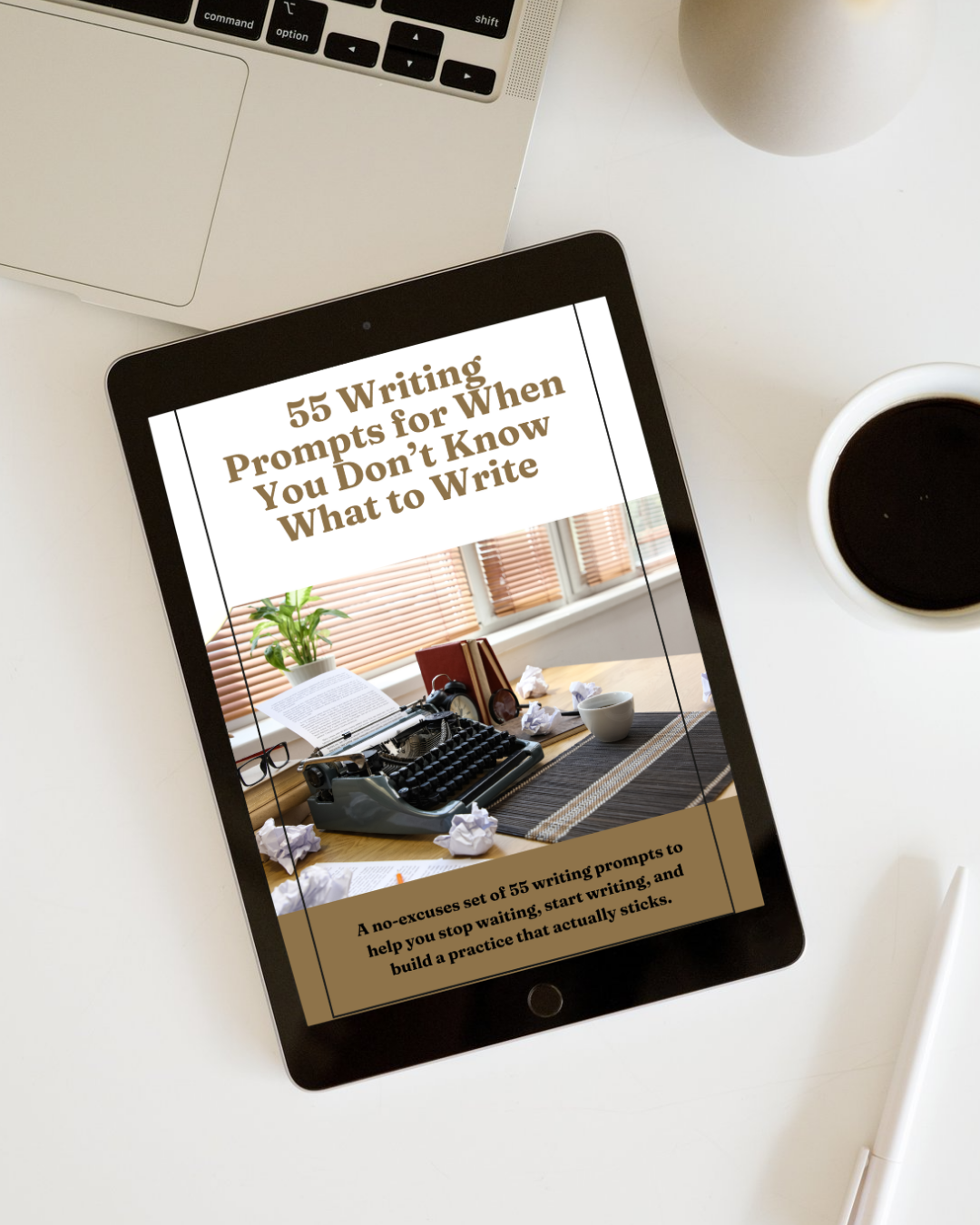
Download 55 Writing Prompts for When You Don’t Know What to Write — For FREE
f you’ve been wanting to write more, but keep getting stuck, distracted, or waiting for inspiration, this is where you start.
This collection of 55 thoughtfully designed writing prompts is created to help you build a real, sustainable writing practice, no matter your schedule, experience level, or genre. Whether you have ten minutes or an hour, these prompts give you an immediate way into the work so you can stop staring at the blank page and start writing.
Inside, you’ll find a range of prompt styles to meet you wherever you are in your process, including reflective prompts, creative story starters, sensory-based exercises, constraint-driven challenges, and open-ended phrases and keywords. Each category is designed to stretch a different part of your writing, helping you build depth, flexibility, and confidence across genres, whether you write fiction, nonfiction, poetry, or personal work.
If you’ve been wanting to write more but keep getting stuck, distracted, or waiting for inspiration, this is where you start.
This collection of 55 thoughtfully designed writing prompts is created to help you build a real, sustainable writing practice, no matter your schedule, experience level, or genre. Whether you have ten minutes or an hour, these prompts give you an immediate way into the work so you can stop staring at the blank page and start writing.
Strong writers aren’t the ones who feel inspired all the time. They’re the ones who know how to write without it.
Inside, you’ll find a range of prompt styles to meet you wherever you are in your process, including reflective prompts, creative story starters, sensory-based exercises, constraint-driven challenges, and open-ended phrases and keywords. Each category is designed to stretch a different part of your writing, helping you build depth, flexibility, and confidence across genres, whether you write fiction, nonfiction, poetry, or personal work.
This isn’t about writing perfectly. It’s about writing consistently. If you’re ready to stop waiting, start showing up, and develop a writing practice that actually moves your work forward, this is for you.